

SAP S/4HANA in Power BI from day one: meet StarShelf
What slows these projects down is rarely the platform. It is the modelling. S/4HANA comes with thousands of CDS views, and none of them is a star schema you can put in front of a business user. Every project rebuilds the same models by hand. Every consultant is on a mission trying to find the correct one.
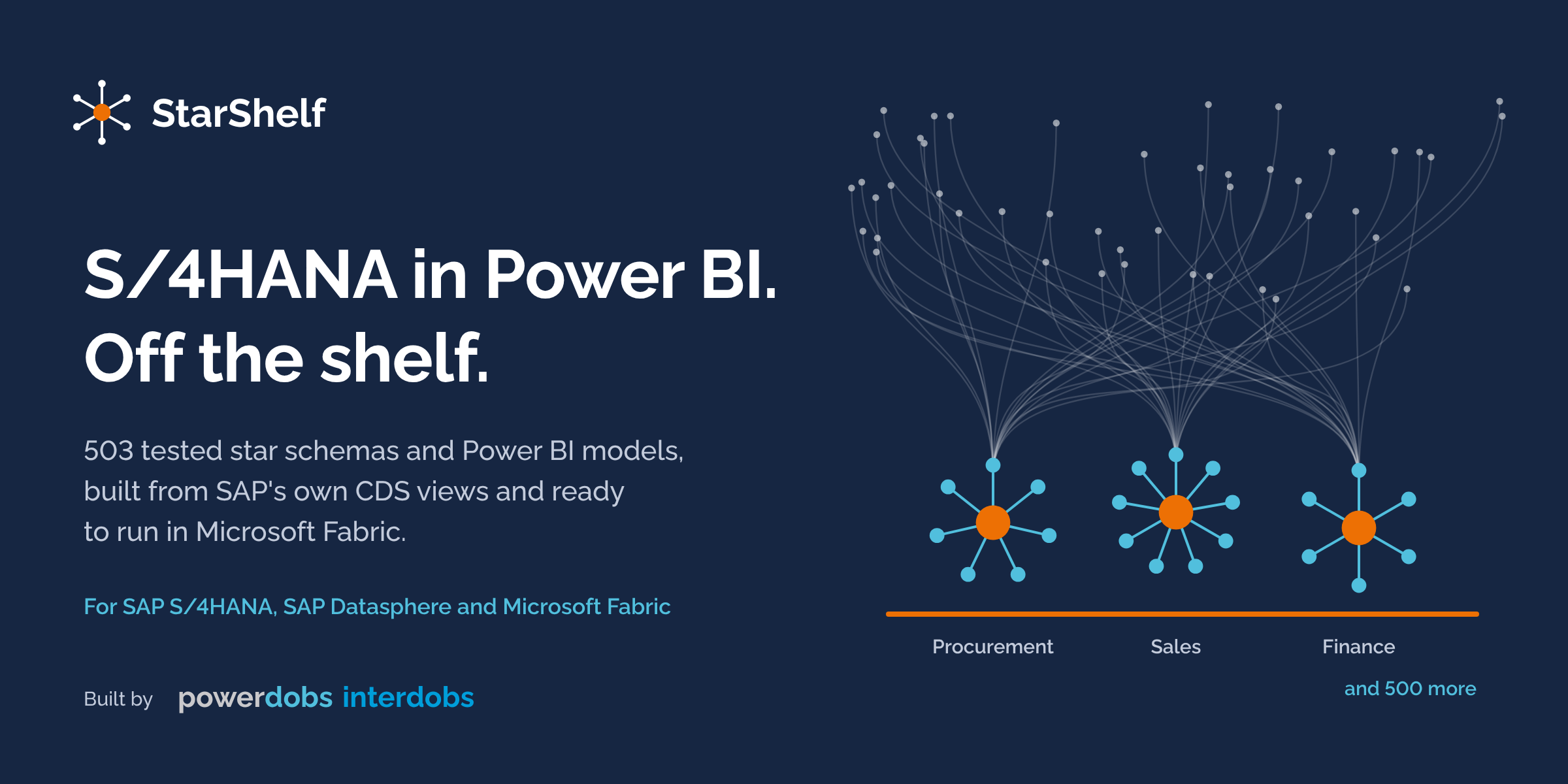
That is why we built StarShelf: a library of 503 ready-made star schemas for SAP S/4HANA, each with its replication flows, its lakehouse tables and its Power BI model. In this post we explain what is on the shelf, how it works and how we tested it.

Why S/4HANA reporting starts from zero
In SAP BW, Business Content gave every project a head start. When reporting moves to S/4HANA and Microsoft Fabric, that head start is gone, and three things take its place.
- Finding the right views takes weeks. Which of the thousands of CDS views hold the facts, which hold the master data, and which can actually be extracted?
- The joins are not written down. How an order item links to its supplier, plant and product, which keys are compound and which master data changes over time: it is all in the view definitions, one view at a time.
- SAP logic gets lost on the way. Amounts in yen look a hundred times too small, texts arrive in every language at once, and totals mix euros and dollars. Every team solves this again, each a little differently.
The result is familiar: weeks of modelling before the first report, and a model that only the people who built it fully understand.
Meet StarShelf
StarShelf is a library of 503 star schemas for SAP S/4HANA, covering finance, sales, procurement, supply chain, projects, maintenance, sustainability and more. They are based on SAP’s own CDS view definitions and the field types of the ABAP Dictionary, and every model is tested before it goes on the shelf.
Each model is complete, from the replication flows in SAP Datasphere to a Power BI semantic model in Direct Lake mode. Everything is readable: plain Spark SQL, standard Power BI model files and Datasphere objects in SAP’s own format. You stay in control of what goes live, and what you get is yours to keep.

How StarShelf works
Every model on the shelf comes with the same six parts.
- Replication flows. One flow per CDS view, ready to import into SAP Datasphere. Views with change data capture load initial and delta, the others in full.
- Landing tables. A Delta table per view in the Fabric lakehouse, derived from the ABAP Dictionary.
- The star schema. One fact, its dimensions with their texts and a date table, built in Spark SQL from the landing tables. It runs in Microsoft Fabric and on Databricks.
- SAP logic. Amounts in the decimals of their currency, conversion to EUR with SAP’s own exchange rates, texts in one language and master data in the version that is valid today.
- The Power BI model. Relationships, measures, display folders and formats, in Direct Lake mode on the lakehouse.
- One notebook. It loads the lakehouse, builds the star schema, checks the result and deploys the Power BI model to your workspace.

One model up close
Purchase Order Item is a typical example. Its fact comes from C_PurchaseOrderItemDEX, SAP’s extraction view for purchase order items, and it links to 16 dimensions and a date table.
A supplier appears three times on a purchase order item: as supplier, as supplying supplier and as invoicing party. StarShelf builds one supplier table with three relationships, one active and two that a measure can switch on. That keeps the model small, and it is what Direct Lake mode needs: one table per dimension.

What it means for your project
StarShelf changes where an S/4HANA reporting project starts.
| Result | What it means for you |
|---|---|
| Start from a working model | Your team starts from a tested model on its own S/4HANA data, not from an empty lakehouse |
| Less manual engineering | Consultants spend their time on what makes your company different, not on joins SAP already defined |
| SAP numbers you can explain | Currency decimals, exchange rates and texts are handled the way SAP handles them |
| No lock-in | Plain SQL, a standard Power BI model and Datasphere objects in SAP’s format, on Fabric or Databricks |
How we tested it
- Every model. All 503 models pass SQL validation, and every Power BI model is read and written back unchanged by the library Power BI itself is built on.
- On Spark. All 3,911 SQL statements of the 16 business areas run on Spark without a single error.
- On test data. Models come with generated test data whose totals are known in advance, so you can try them in your own lakehouse before there is an SAP connection.
- On a real system. Generated replication flows run in a live SAP Datasphere tenant against an S/4HANA system, with tables, columns and types exactly as generated
StarShelf and WavePath
If you are leaving SAP BW, WavePath migrates what you built yourself in BW towards modern hybrid data platforms. StarShelf gives you the standard S/4HANA models that BW Business Content used to provide. Together they cover both halves of the move away from BW.
See it on your own system
We are happy to show StarShelf on your own S/4HANA system. We pick one process, connect it and show you the Power BI model on your own data. Get in touch at Mark Rez.