


Fabric IQ: When Your Data Platform Starts Thinking
FabCon Atlanta is just in the books, and I am still processing everything that was announced. There was a lot. If you want the full picture, I recommend starting with my blog on the latest Fabric and Power BI updates.
But in this post, I want to focus on the one announcement that I keep coming back to: Fabric IQ.
I think it is the most strategically significant thing Microsoft announced, and also the one that will have the most practical consequences for how we design Fabric solutions at Powerdobs. Let me explain why.
The Problem: Your Data Platform Knows Everything and Does Nothing
Before I get into what Fabric IQ is, let me sketch the situation it is responding to.
Most of our clients have come a long way with their data platform. They have OneLake, they have Lakehouses, they have Warehouses and semantic models and Power BI reports. The data is there. It is governed, it is fresh, it is trusted (I know, that’s the ideal situation 😊).
But when something happens in the business, the process still looks like this: a report alerts a human, the human reads the number, the human decides, the human opens another system, the human acts. Every step in that chain is a handoff, and every handoff is a potential delay or mistake.
AI is changing the expectation here, fast. I hear it more and more from clients: “Can’t the system just do something?” That is the gap Fabric IQ is designed to close.
What Is Fabric IQ?
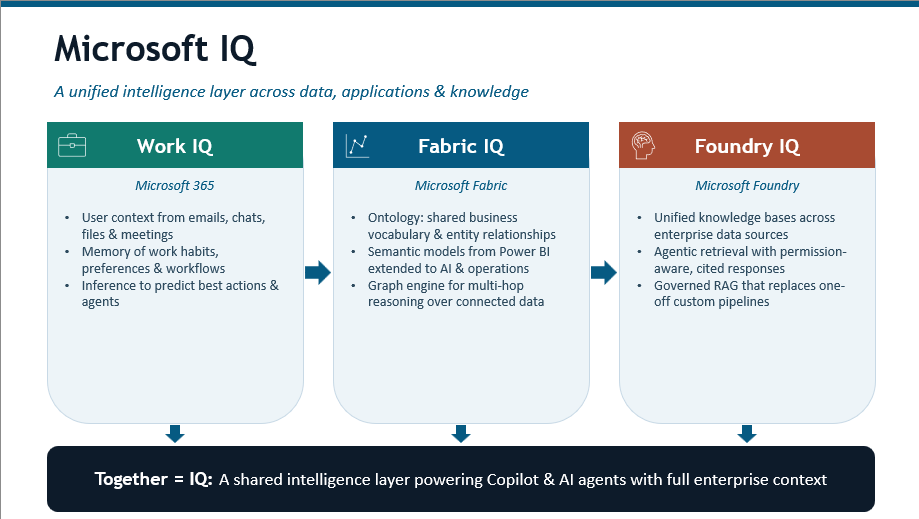
Fabric IQ is a semantic intelligence layer built directly into Microsoft Fabric. It was announced with a clear GA direction at FabCon 2026.
The core idea: Fabric IQ exposes your data estate to AI agents, but not just as raw schema. It exposes it with meaning attached. Tables, relationships, business logic, and definitions are wrapped into an ontology that agents can query and reason about.
The distinction matters more than it sounds. Without something like Fabric IQ, an AI agent querying your Fabric environment sees column names and data types. With Fabric IQ, it understands that fk_order_id is an Order, that an Order has a ShipmentStatus, and that “at-risk” means the SLA window is under 48 hours. That is the difference between a tool that guesses and a tool that knows.
A few things that stand out to me about the implementation:
- It layers on top of what you already have. Your existing Power BI semantic models and OneLake data feed into the Fabric IQ ontology. You are not starting from scratch.
- Security is not an afterthought. Fabric IQ respects your existing Fabric RBAC. Agents only see what their delegated Entra identity is already allowed to access. No separate permissions layer to manage.
- MCP is the interface. Fabric exposes IQ through the Model Context Protocol, which means external AI agents (including GitHub Copilot and your own custom agents) can connect to it using a standard they already understand. Fabric local MCP and Fabric remote MCP were both announced at FabCon, and the remote MCP is a particularly interesting one for enterprise scenarios.
The Combination to Watch: Fabric IQ + Translytical Task Flows
Fabric IQ does not operate in a vacuum, and the announcement that amplifies it most is Translytical Task Flows, which reached general availability at FabCon.
Task Flows let users act directly from Power BI reports: trigger a workflow, update a record, escalate an issue, all without leaving the report surface. That on its own is already a significant capability.
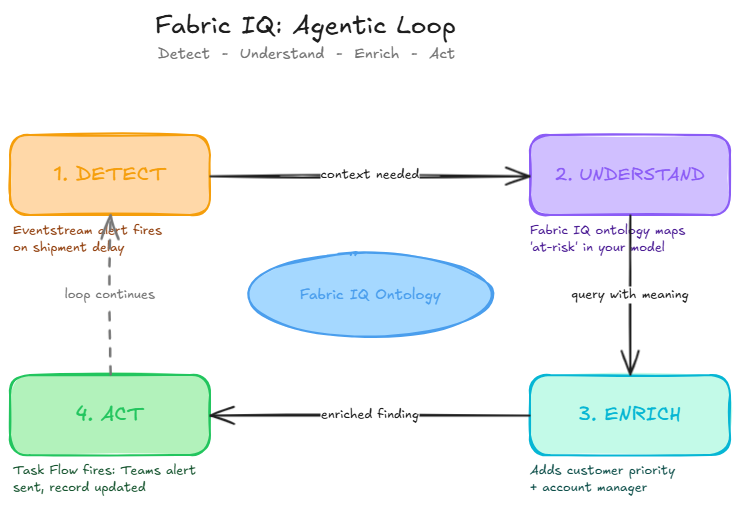
But pair it with Fabric IQ and the picture changes completely. An AI agent can now:
- Detect something in your data (via a Fabric Eventstream alert, a scheduled check, or a direct query)
- Understand what it means, using the ontology in Fabric IQ
- Enrich the finding with related context from OneLake or the semantic model
- Act, by triggering a Translytical Task Flow that writes back to an operational system or sends an alert via Teams
Zero human clicks for the full loop. That is what I mean when I say this is a closed-loop architecture. And I think this combination, Fabric IQ providing the context layer and Task Flows providing the action layer, is what agentic analytics actually looks like in practice. Not chatbots layered on top of dashboards, but genuine automated reasoning and response.
What This Means for How We Design Fabric Solutions
I want to be honest here: I have not run Fabric IQ end-to-end in a production environment yet. This is freshly announced, and parts of it are still in preview. I am watching the GA timeline carefully before recommending it for production adoption at clients.
That said, the architectural implications are real right now, and there are things you should start thinking about today.
Your semantic layer quality is now a direct AI asset
For years, we have been telling clients to invest in a well-built semantic model: good naming conventions, proper relationships, descriptions filled in, measures documented. The business case was always about maintainability and trust.
Now there is a second business case: the quality of your semantic model directly determines how useful Fabric IQ is for your AI agents. A model with descriptive field names, documented measures, and clean relationships gives agents real context to work with. A model with col_A, fk_id_3, and no descriptions gives agents almost nothing.
Tech debt in your semantic layer just became a lot more expensive.
Security design has to keep up with agent identities
The introduction of agent identities into your Fabric environment is not a small change. At FabCon, Microsoft also announced Workspace Identities reaching general availability, which gives workspaces their own managed identity for service-to-service scenarios.
Together with Fabric IQ and MCP, this means you need to think about RBAC not just for human users, but for automated principals. Build that into your governance model now, before agents are in production and you are retrofitting access controls.
Start learning MCP before your clients ask about it
Model Context Protocol is not Fabric-specific. It is an open standard, and it is gaining traction fast across the AI ecosystem. Understanding what MCP is, how it works, and how Fabric exposes itself through it will be a prerequisite for advising clients on agentic data architectures.
At Powerdobs, we are already investing time here. I suggest you do the same.
The Honest Take
I am genuinely excited about Fabric IQ. The architecture is sound. Microsoft is not bolting AI onto Fabric as an afterthought; they are building it into the data layer itself, which is a fundamentally different approach.
At the same time, the biggest risk I see is organizational, not technical. Companies that have neglected semantic model quality, governance, and documentation for years will have a harder path to value here. The tooling is ready before the data estate is, and that is a pattern we see repeatedly with new Fabric capabilities.
The organizations that will move fastest with Fabric IQ are the ones that already have clean OneLake architectures, well-maintained semantic models, and mature Fabric governance. If that describes your environment, this is a serious opportunity. If it does not, that gap just became more urgent to close.
Wrap-Up
Fabric IQ, combined with Translytical Task Flows and a solid OneLake foundation, is the closest I have seen Microsoft come to delivering a genuinely intelligent data operating system, rather than a collection of connected tools.
It is early. Watch the GA dates. But start thinking now about what your semantic layer looks like from an agent’s perspective.
Three things I would suggest:
- Read Arun Ulag’s FabCon hero blog for the full platform picture
- Check the Fabric March 2026 Feature Summary for the detailed breakdown
- Audit one of your semantic models this week. Ask yourself: if an AI agent read this, would it understand what your business actually does?
Want to talk through what Fabric IQ means for your specific data architecture?
We at Powerdobs are happy to think along.
